The Most Common Injuries We See in Active Pinellas County Patients, And How to Avoid Them
Living in Pinellas County means you have almost no excuse not to move. The weather is good most of the year, the trails and beaches are accessible, the water is right there. People here run, cycle, paddleboard, play beach volleyball, swim, do yoga on the sand, and generally stay active well into their 50s, 60s, and beyond.
That's something I genuinely love about this community.
But movement means load on the body and the injuries I see in my Largo clinic follow a very predictable pattern based on what people around here actually do. After 35 years of treating active patients, I can spot the lifestyle from the injury almost every time.
Here's what we see most, and what actually helps.
Plantar Fasciitis: The Runner's Nemesis
If you run along the Pinellas Trail, on the beach, or through your neighborhood on pavement, you've either had plantar fasciitis or you know someone who has. It's the sharp heel pain that's worst first thing in the morning, that first step out of bed that makes you wince.
The conventional advice is to stretch it, ice it, and rest. That might help manage it. But the reason it keeps coming back for so many runners is that the root cause, usually a combination of mechanical misalignment, SI joint restriction, calf tightness, weak foot intrinsic muscles, and poor load distribution, never actually gets addressed.
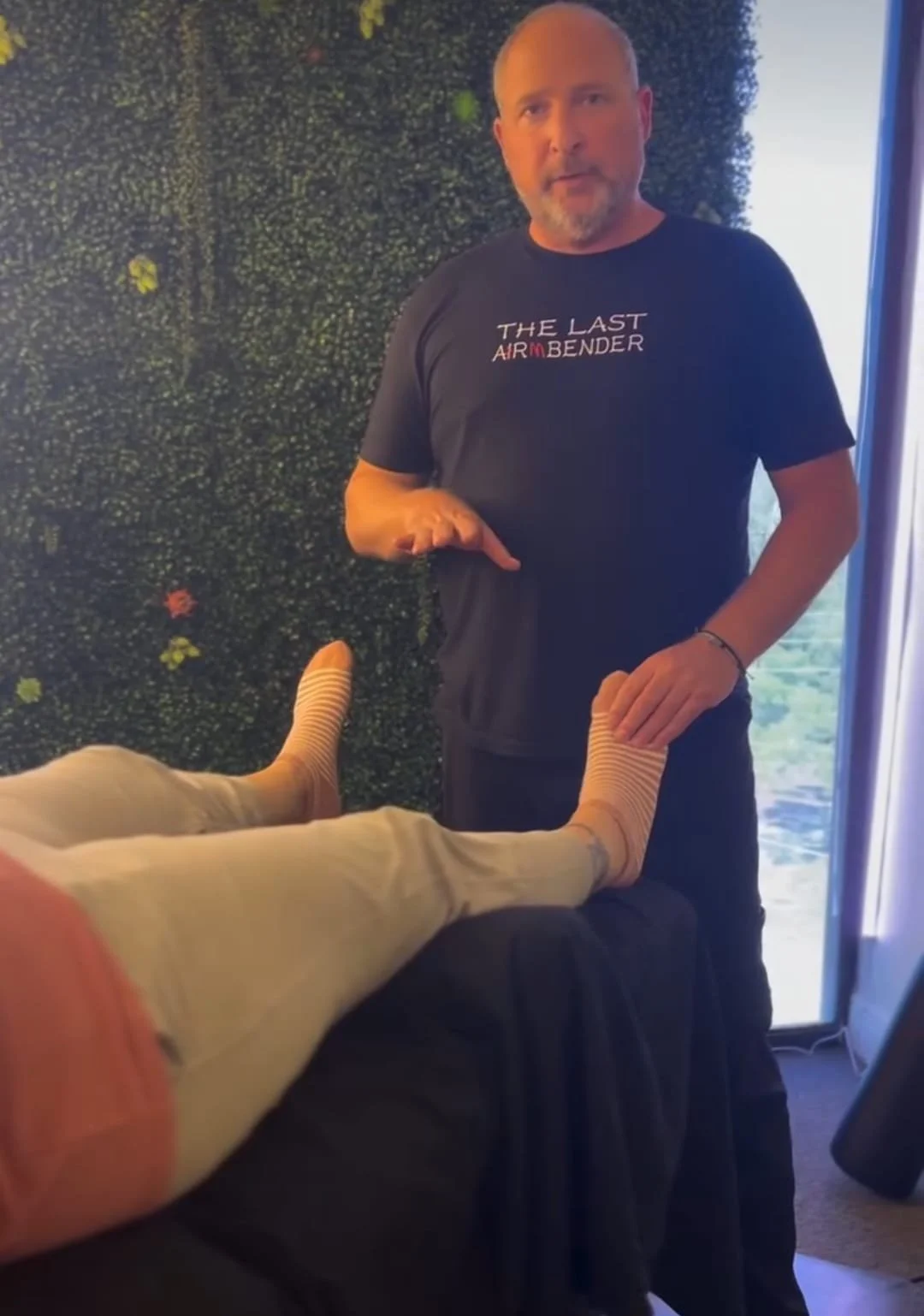
Manual therapy works exceptionally well here. Hands-on work to the plantar fascia, the calf, and the ankle joint combined with targeted loading exercises typically resolves this in 2–3 visits. Most patients who've been dealing with it for months are surprised how quickly it turns around with the right approach.
Shoulder Pain: The Beach Volleyball and Swimming Tax
Overhead athletes take a beating. Beach volleyball players, swimmers, tennis players, even paddleboarders all of them load the shoulder in ways that accumulate over time. Rotator cuff irritation, impingement, and bicep tendon issues are the most common presentations.
The mistake most people make is stopping activity entirely and waiting for it to go away. Sometimes it does. More often, the underlying movement dysfunction that caused the problem stays in place, and the pain comes back the moment you return to the court or the water.
What we do instead is identify exactly where the breakdown is happening is it a mobility issue at the thoracic spine? A strength deficit in the lower trapezius? A technique problem loading the shoulder in the wrong position? and fix that, not just the symptom.
IT Band Syndrome: The Cyclist's Constant Companion
Pinellas County has excellent cycling infrastructure, and a lot of people use it. IT band syndrome is the predictable result of significant cycling volume, especially when bike fit isn't dialed in or when someone ramps up mileage too fast.
The lateral knee pain that comes on predictably at the same point in a ride usually around 20–30 minutes, and then eases when you stop is the classic presentation. Foam rolling the IT band itself is almost always the first thing people try. It rarely solves it, because the IT band isn't the problem, it's the symptom.
The real issue is usually hip abductor weakness causing the femur to rotate inward under load, increasing tension on the IT band. Address the hip, and the knee stops complaining.
Low Back Pain: What Sitting on the Water Does to Your Spine
Kayakers, paddleboarders, boaters, fishermen, extended time in a seated or slightly flexed position on the water is a surprisingly common source of low back issues. Add the rotational demand of paddling and you have a recipe for SI joint irritation and lumbar muscle fatigue.
We also see plenty of low back pain in people who are otherwise active on land but spend their work hours at a desk. The body doesn't compartmentalize. Eight hours of sitting compresses the same structures you're then asking to perform on the Pinellas Trail after work.
Manual therapy to the lumbar spine and SI joint, combined with the right movement pattern corrections, is consistently the fastest path out of this. Most patients improve significantly after the first session.
Knee Pain: The Pickleball Boom
Pickleball has exploded in Pinellas County, courts are packed, and a lot of the players are people who haven't done lateral, stop-start movement in years. The result is a wave of knee pain presentations we weren't seeing five years ago.
Meniscus irritation, patellofemoral pain, and medial knee strain are all common. The good news is that most recreational pickleball knee injuries are not structural damage they're load management problems that respond well to manual therapy and a brief, targeted strengthening program.
The Common Thread
Whatever the activity, the injuries I described above share something: they're not random bad luck. They're the predictable result of load meeting a vulnerable structure. Identify the vulnerability, correct it, and the injury either resolves or stops recurring.
That's the manual therapy approach. Not just treating the painful area, but understanding why that area was vulnerable in the first place.
Most of my active Pinellas County patients are back to full activity within 3 visits. That's not a promise it's just what tends to happen when the root cause gets addressed instead of managed.
Ready to Get Moving Again?
If one of these sounds familiar, you don't need to wait it out or work around it indefinitely. Florida's direct access law means you can come straight to us — no referral needed.
Largo clinic: Mon–Fri 9am–6pm | Sat 9am–1pm
St. Petersburg clinic: Wednesdays 10am–1pm (420 94th Ave N)